


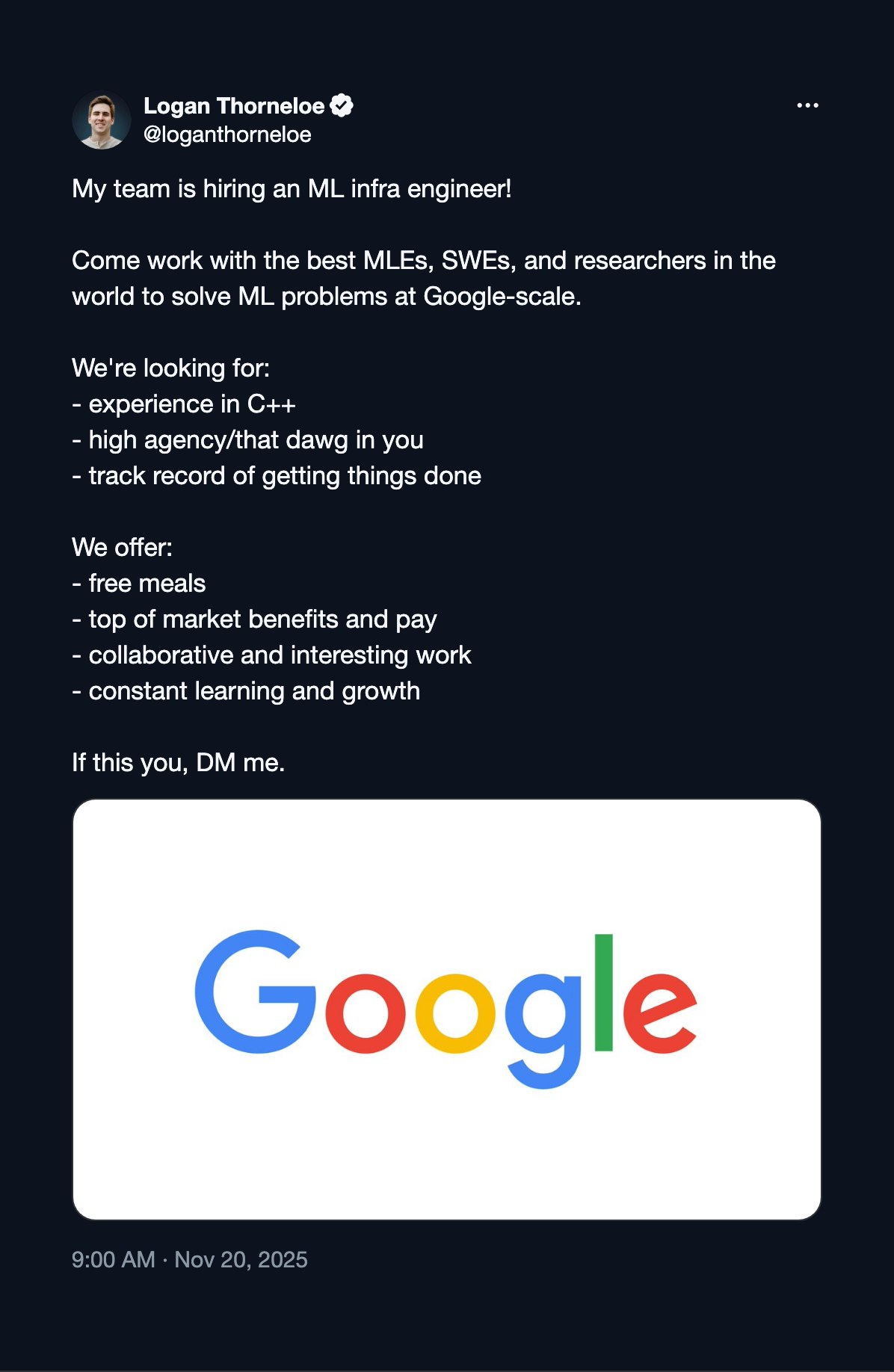
Last week I posted a role my team is hiring for on X and LinkedIn (check them out because we’re still hiring!) and I received hundreds of messages. Sorting through them made one thing clear—people suck at presenting themselves.
It’s a tough market right now and differentiation is more important than ever. Most great jobs aren’t found by cold applying to positions, but through one’s network. DMs are the new cover letter and understanding how to DM properly is paramount to optimally present oneself.
This article uses my experience on the hiring side of DMs to teach you how to DM for a job properly. I share this primarily because I think it’s important and AI for Software Engineers readers should stand out, but also because I learned a lot about what I was doing incorrectly too.
I’ve split this into five parts. In this new
sletter, I explain:
The current job climate and why that’s the first thing to understand.
How to set up a good elevator pitch.
Why your resume is still important.
The things you should avoid.
One final tip.
1. Understand the current job climate
The current job market is weird. Overall demand for software engineers has gone down, but demand for developers with experience in AI is at its peak. This means we have a lot of people competing for jobs, but for many roles there are very few qualified applicants.
To put things into perspective, only a few hours after posting about the open role, I had ~100 DMs on X and about half that on LinkedIn. Over the next few days, I had hundreds on both platforms. Yet, only a small group of candidates were actually a good fit.
In the current job market, you should understand that:
You need to stand out immediately. Your messaging should be efficient.
A response may be delayed. You shouldn’t expect a response in hours or even up to a day. Be smart about when you follow up.
You may never get a response. Responding to everyone isn’t feasible due to volume.
You need to be prepared. Your resume and other supporting materials should be ready to go.
Your goal is to make it easy for the person reviewing your experience. I can’t emphasize this enough: Making it easy for the person to review your work makes a huge difference in how likely you are to make it further in the hiring process.
With these things in mind, let’s figure out how we can make this process easy.
2. Developing a good elevator pitch
Update: After spending a lot of time going through DMs I realized it makes my life a ton easier when a person sends their resume immediately with their elevator pitch. Send it as a pdf via shareable link (such as Google Drive).
Your goal with your first message should be to fit enough information in a blurb readable in fifteen seconds to make the person feel they’re missing out on talent if they don’t respond to you.
There are two things to pull from that.
First, your message should be readable in fifteen seconds or less. If you send a wall of text containing your entire CV, it won’t be read. You’ll be skipped and the person hiring won’t think twice. They simply don’t have time for this. Remember, you don’t need to list all your experience, just the most relevant and recent.
Second, your message should be convincing. It should figuratively scream “I’m the person for this job.” So many people fall into the trap of just sharing what they do instead of the impact they’ve had.
Those hiring care much more about the outcome of work than the work done. When you share the impact your work had, you’re also forced to get into more detail about it. Descriptions of ‘what someone has done’ tend to be generic. I can’t tell if you’re the right person for the job based on a vague description of work. I can tell much better if I understand the outcome of that work.
I responded to so many people with ‘Tell me more about your work’ because they only sent me a generic description of what they did. In many cases, when they responded with more detail, their work was much cooler than they had originally made it seem.
Here’s a bad DM:
“Hi, I’m a software engineer with 5 years of experience in AI and machine learning. I’ve worked at Company X and Company Y building models. Let me know if you want my resume. Interested in your role.”
Here’s a good, very similar DM:
“Saw your AI engineer role—I’ve built production ML systems at Company X that boosted user engagement by 35% using PyTorch and deployed via AWS. Resume: [link]. Excited to chat about how I can contribute.”
Outside of the content, notice how the second message sent a resume link immediately. This isn’t a link to a LinkedIn profile, portfolio, or personal site. This is a link to a polished resume. The reader doesn’t have time to visit a website for everyone to look for information. You need to bring the info to them.
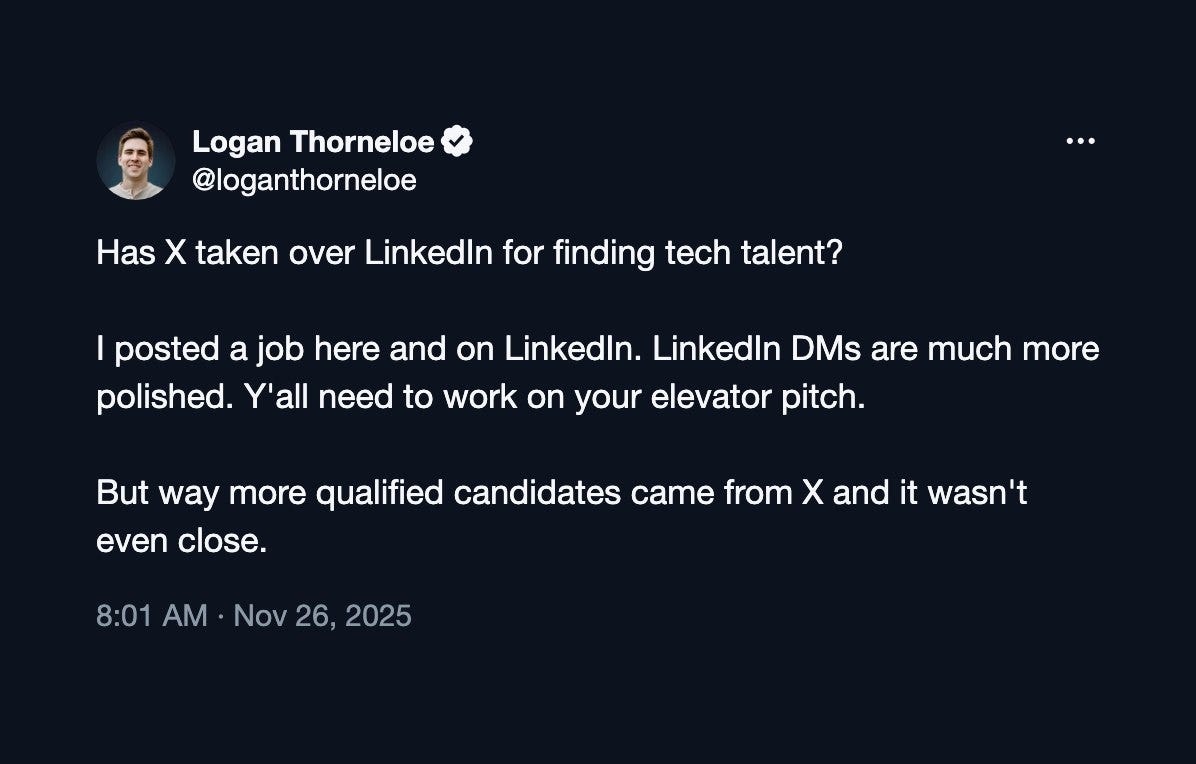
Interestingly, the quality of DMs on LinkedIn was much higher than X in general, but qualified candidates overwhelmingly came from X.
3. Your resume is still important!
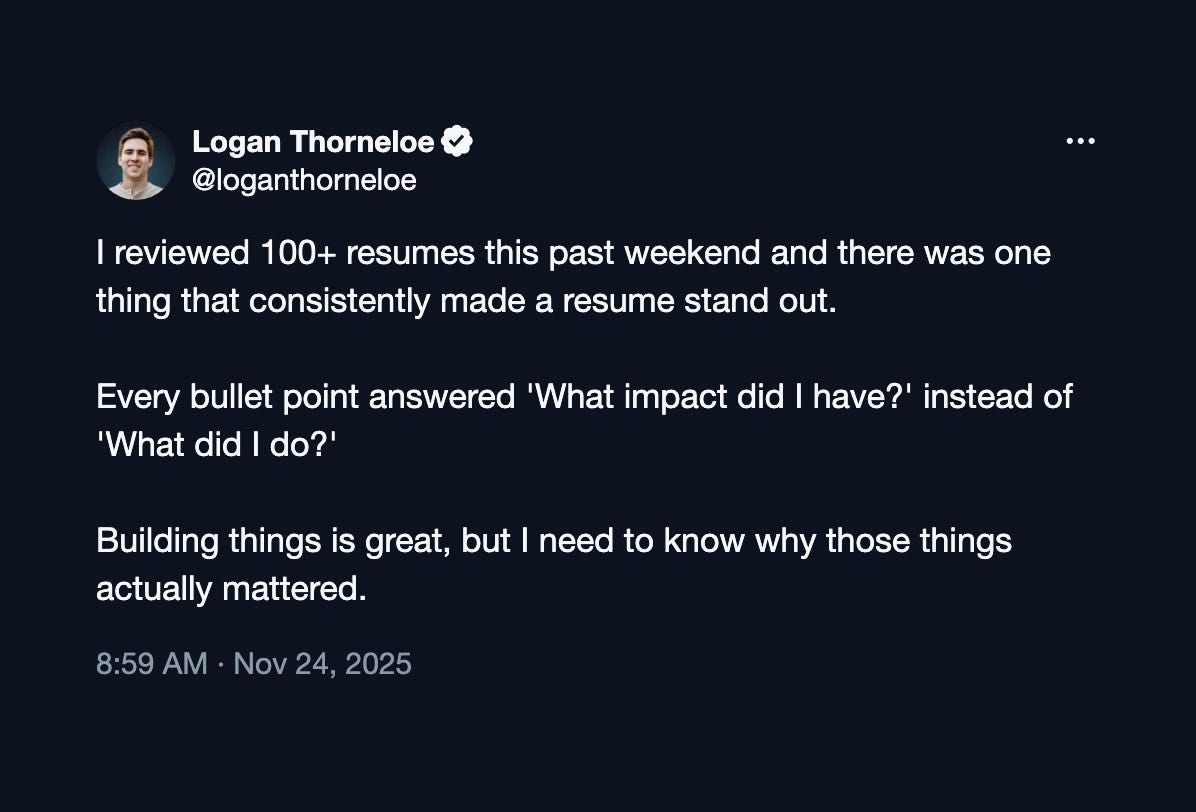
The number one issue I see when looking over resumes is bullet points that share what someone did instead of the impact they had. I mentioned this in the previous section, but it’s by far a bigger issue on a resume than in a DM.
When you focus resume bullet points on the impact of your work, you’ll not only share what the work was, but why it was important and better communicate what you’re capable of.
A bad bullet point:
“Trained machine learning models for image recognition using TensorFlow.”
A good bullet point:
“Achieved 92% accuracy for image recognition tasks and reduced image processing time by 40% by training a machine learning model on a 50k-image dataset using TensorFlow.”
To write excellent resume bullet points, I recommend the XYZ formula: “Accomplished [X] as measured by [Y], by doing [Z].” You can find more examples of good and bad bullet points at that link.
The second issue is poor formatting and non-important information. Your resume should be a single page. Those hiring won’t have time to look at a second. The single page should contain the most relevant information first and call attention to the technologies and skills your work shows you have.
Your resume should not contain a skills section that lists your proficiency in languages and technologies. Those proficiencies should come across in your bullet points. As you share your impact, include what you used to make that impact and bold those technologies so they stand out.
Take care to draw attention to the technologies listed in the job description. This is a really easy way for a recruiter (especially one with a non-technical background) to decide you might be a fit for a role.
Some examples of this:
“Increased user retention by 25% for a platform with 1M+ daily active users, by leading development of scalable recommendation engine using Python, PyTorch, and Kubernetes.”
Or:
“Increased user retention by 25% for a platform with 1M+ daily active users, by leading development of scalable recommendation engine (Python, PyTorch, Kubernetes).”
The fourth issue I see is candidates not being honest about their experience. I’ve seen very few people outright lie about their experience but I’ve seen a lot of people embellish it. Lies and embellishments come across very quickly when having an actual conversation with someone about what they’ve done and it doesn’t look good.
This also frequently comes across when looking over someone’s resume. The experience listed in your DM should match the experience listed on your resume. I should be able to look at your resume and think “That’s what they were talking about.” I’ve seen too many resumes that seem like an entirely different candidate than was portrayed via DM. That’s a red flag to me.
The final issue I see in resumes (and very frequently when chatting with candidates) is using the term we or similar group phrasing. Your resume and candidacy are about you. You need to specifically share the impact you had.
A tip: Tailor your resume to each job listing. Other candidates are doing this and you’re competing with them. You should match your experience exactly with what the hiring team is looking for if you want the best chance of making it through to the hiring rounds.
4. Things not to do
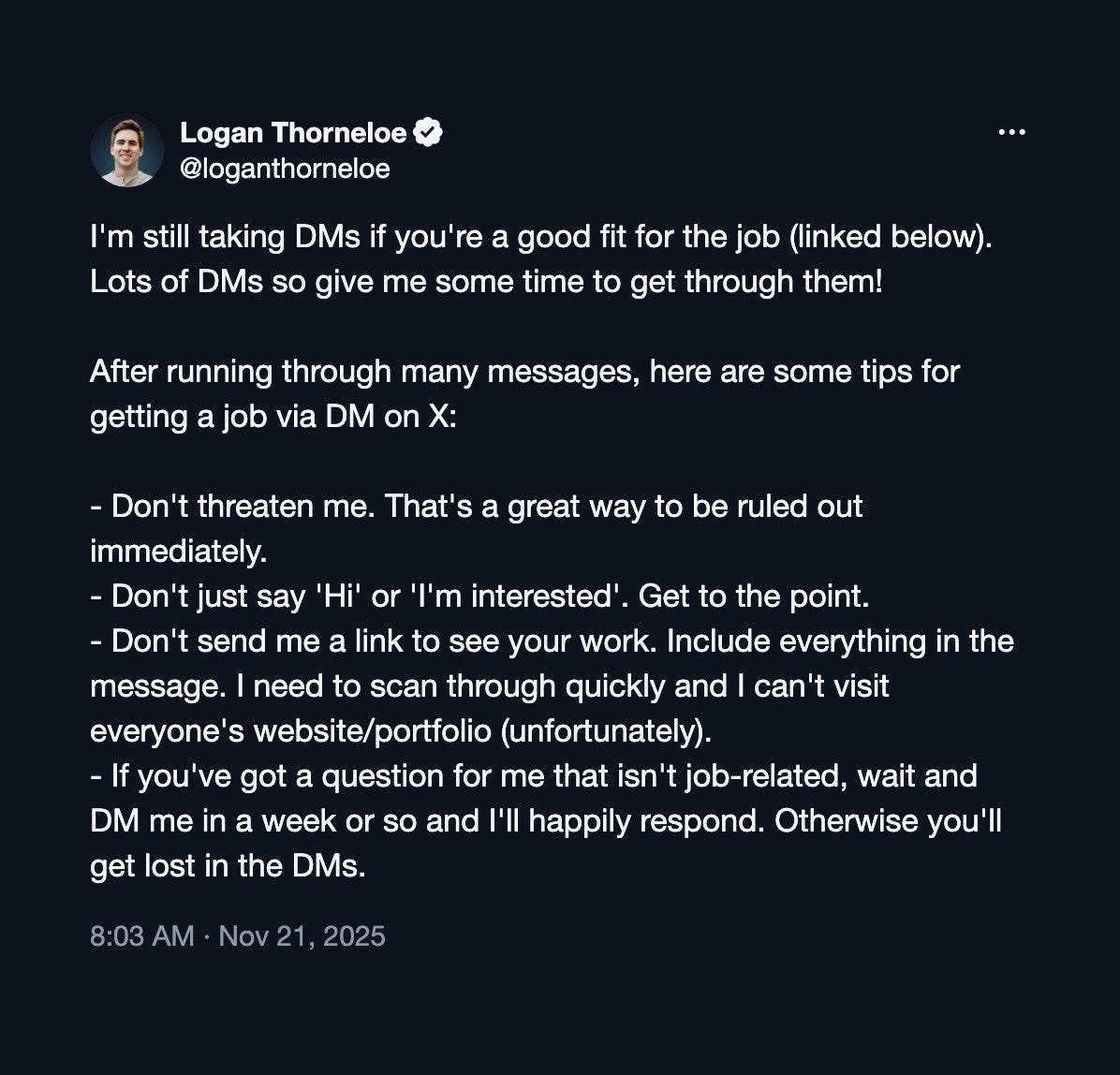
Before we finish, here are a few things you shouldn’t do when messaging someone for a job opportunity. I experienced all of these and more this past week.
Don’t spam (in messages or elsewhere). Many people would follow up with a ‘gentle ping’ two hours after sending their previous message. Remember, the person you are messaging is looking for someone to work with. Be respectful because they definitely won’t want to work with someone who isn’t.
Don’t use AI for these messages. It’s very obvious and a very quick filter anyone can use to eliminate candidates. If you’re using AI to write, your DM will be poorly written and super generic. It only takes a minute or two to draft a worthwhile message.
Don’t be threatening. I don’t know if this is a result of the alpha male mentality spread around the internet, but anyone telling me I must hire them or I’ll regret it is immediately disqualified.
Don’t just say ‘hi’. This is a good rule of thumb for all professional communications. Time is limited and sending ‘hi’ is a waste of it. Get right to the point.
Don’t DM just because you want to ask a question, yet. This isn’t because it’s disrespectful, but simply due to logistics. I’m happy to answer questions via DM, but I won’t have time when filtering through job-related messages.
One final tip: Do things in public. Learn new skills, build cool things, and share what you’re doing online. This is the differentiating factor for getting a job in the current market.
If I’ve missed anything, leave it below! Thanks for reading.
Always be (machine) learning,
Logan
This was a very good read! I've always struggled a bit to understand how to send a good cold message to someone during a job search. Good examples here