



Dr. Richard W. Hamming wrote an essay on how to direct one’s research called ‘a stroke of genius: striving for greatness in all you do’. It’s a derivative of his much longer lecture called ‘You and your research’ and is about what makes a person a successful researcher.
This is a must-read for all researchers or engineers working in AI. It not only gives good direction regarding research, but also generally good insight into directing one’s career and focusing on solving the right problems.
I’ve broken down the primary takeaways for engineers and what they mean. I hope reading this can help you gain a better understanding of the various factors that go into successful work.
Choosing the right problem
One recurring theme we see in the AI community is direction. AI has radically changed software engineering and there are many applications of AI yet to be worked on. When the breadth of what you can focus on is no longer a bottleneck, deciding the direction in which you work becomes increasingly more important.
You can work on multiple projects and make progress in all of them, but making progress in the right direction determines the impact of that work. In engineering, this is most often discussed in the context of understanding what work is important and focusing on that.
This has a parallel in research and Dr. Hamming covers it in the passage below:

Before successful researchers begin their work, they ensure the work they’re focused on has meaning. They make sure they’re pointed in the right direction.
Similarly, there are many directions the everyday work of an engineer can take. The most successful engineers can narrow down the directions worth pursuing. It was crazy to me when I realized just how much of software engineering is managing work: Ensuring you’re working on the right tasks and your time isn’t consumed by less important things.
With agentic engineering expanding the limit of what you can do, it’s become even more important to recognize what you should be doing.
Obsession
One of the traits I’ve noticed about successful people is their motivation is generally the same: They find a problem they’re genuinely invested in. This is a problem they can’t stop thinking about.
This obsession drives their success. The hardest problems aren’t solved due to talent or ability, they’re solved due to an unrelenting need to do so. This was another trait Dr. Hamming pointed out:

There are many ways to approach a job in software engineering. Some people are genuinely interested in it and work because they enjoy it. Others do what needs to be done for work and enjoy the job simply because its a good job and supports other hobbies. Some are a mix of both.
Regardless of which you are, you’ll always have a better time at work if you’re working to solve something you are genuinely invested in. The most successful people in the world find this interest and go all in. These people aren’t necessarily the most talent or intelligent, but they are the most driven.
Collaboration
Advancements in research are made by building upon the findings of others. Novel, impactful findings are generally the result of multiple groups and/or individuals sharing their findings openly with the community and enabling the community to advance them. Dr. Hamming directly calls this out as one of the traits of great researchers:

He makes a further comment about the importance of collaboration by calling out the necessity to discuss work with others. This can be as keeping one’s office door open to invite conversation:

Software engineering is a collaborative discipline. This is largely due to the complexity of the problems being solved. More complex problems generally require more minds and more hands. Collaboration is necessary to ensure successful software systems.
While heads-down work is the ideal for getting things done, heads-up time is great for directing that work. The greatest minds in engineering are eager to discuss their work and the problems they want to solve.
Hard work and luck

I often get the impression that most software engineers believe the best engineers are those gifted with extreme intellect. In reality, the best engineers are those that work hard to understand and use that understanding to drive outcomes.
There hasn’t been a single important problem in the history of mankind that has been solved without hard work. All successful individuals in history (in science and engineering) have been hard workers.
Even obsession needs action to lead to a successful outcome.
Similarly, I’ve seen success blamed on luck. Dr. Hamming calls out one of my favorite sayings, “Luck favors the prepared mind”:

There certainly is an element of luck when it comes to the opportunities available to a person, but those opportunities aren’t rewarded without the preparation required to maximize them. Thus, luck plays a part, but hard work and preparation determine success.
This is also why those who get lucky in their opportunities once tend to luck out again. Maximizing opportunities tends to lead to more opportunities down the road. This is especially true in a discipline like software engineering where hiring bars are high and the work can be difficult.
Sharing your work
There hasn’t ever been a more important time in software engineering history to publicly share your work.
AI has made it increasingly difficult for potential employers to get signal from interviews. There’s now the concern of candidates cheating and the even greater concern of whether or not conventional interviews provide proper signal for companies during their hiring process.
What doesn’t lie is publicly displayed bodies of work. This is the best way to prove impact to your peers. This can be as simple as writing a blog and social posts explaining your work or as complex as a YouTube Channel with hands-on tutorials related to topics you’re familiar with.
Dr. Hamming emphasizes the importance of one sharing their work in science and research.
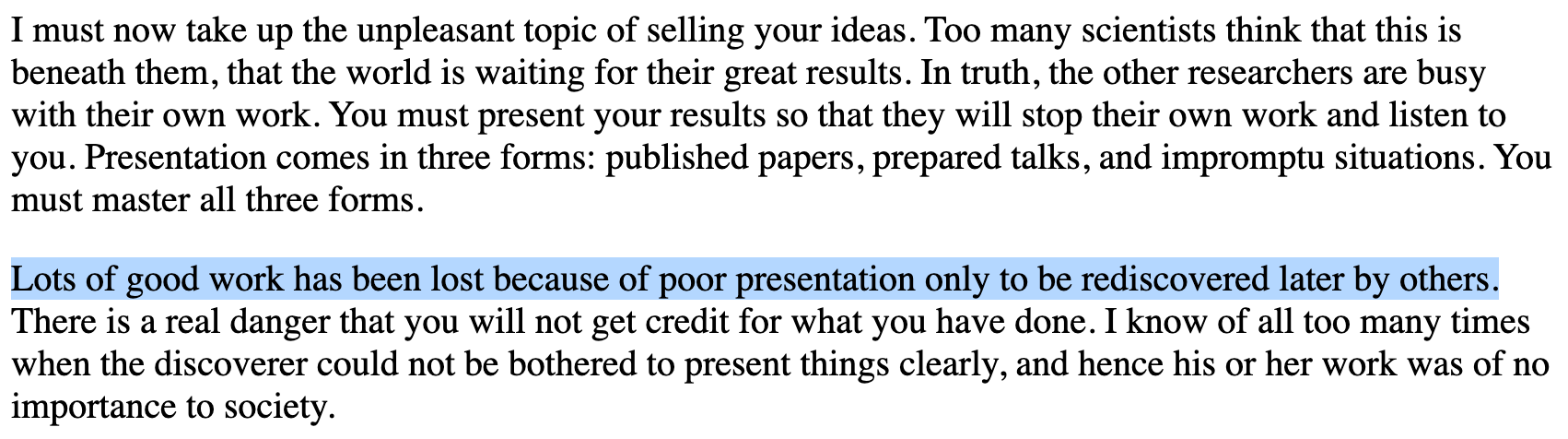
Your work can only be deemed important if others know about. Don’t be afraid to share your work online.
Thanks for reading!
Always be (machine) learning,
Logan