



Hello everyone!
Due to travel and work, this month has been busy. The article below covers something I’ve been thinking about and working with for a long time. I hope you enjoy it! More articles coming soon. I’ve got plenty of topics in the backlog.
Also, I’ve got a new subscriber perk officially coming out this weekend. Stay tuned! Thanks to all of you for supporting AI for Software Engineers.
Logan
I’ve wanted to write about agent benchmarks and their effectiveness, and reading this note recently has finally pushed me to do so:
Every major AI release claims an improvement on industry-leading benchmarks, and every release is met with a wave of complaints that the real-world user experience doesn’t live up to those scores. This is especially true for small models competing near the frontier, which often score well on major benchmarks while falling short in actual usage.
Fundamentally, benchmarks are flawed and ineffective as the sole measure of agent performance. This is due to the nature of agents, the difficulty of engineering benchmarks, and how easy it is to overfit to them. While benchmarks are useful for quantifying specific, scoped capabilities, knowing whether an agent works on real-world tasks relies much more on understanding the user experience.
Thus, to have a complete picture of their agent’s performance, all AI engineers need to understand the flaws of benchmarks so they can use them effectively to improve their agents.
Below, we’ll look at why benchmarks fall short on their own and how to supplement what benchmarks tell us by evaluating agent performance and user experience through trajectory analysis and side-by-side comparisons.
What a benchmark is
First, we must understand what a benchmark is. Benchmarks are built by identifying something we want an agent to be good at and creating a set of evaluations that are indicative of an agent’s performance on related tasks. The key idea behind a benchmark is to give a quantifiable measurement of agent performance within a certain domain.
Benchmarks are typically designed to be agent- or model-agnostic (depending on what is being tested) so we can plug different agent configurations into the benchmarks and see how their performance compares, which lets us hillclimb on agent capabilities within that domain.
While most people think of industry-level benchmarks, application-specific benchmarks should be built by all AI engineers during agent development and used to hillclimb on agent capabilities. Understanding the flaws of benchmarks and how to supplement them is vital for any AI engineer.
Anthropic’s diagram below shows the core pieces of an agent evaluation, from the evaluation harness and suite running trials through the agent harness to graders scoring both the trajectory and final environment state. These components work together to run and grade multiple benchmark tasks for a given agent configuration.
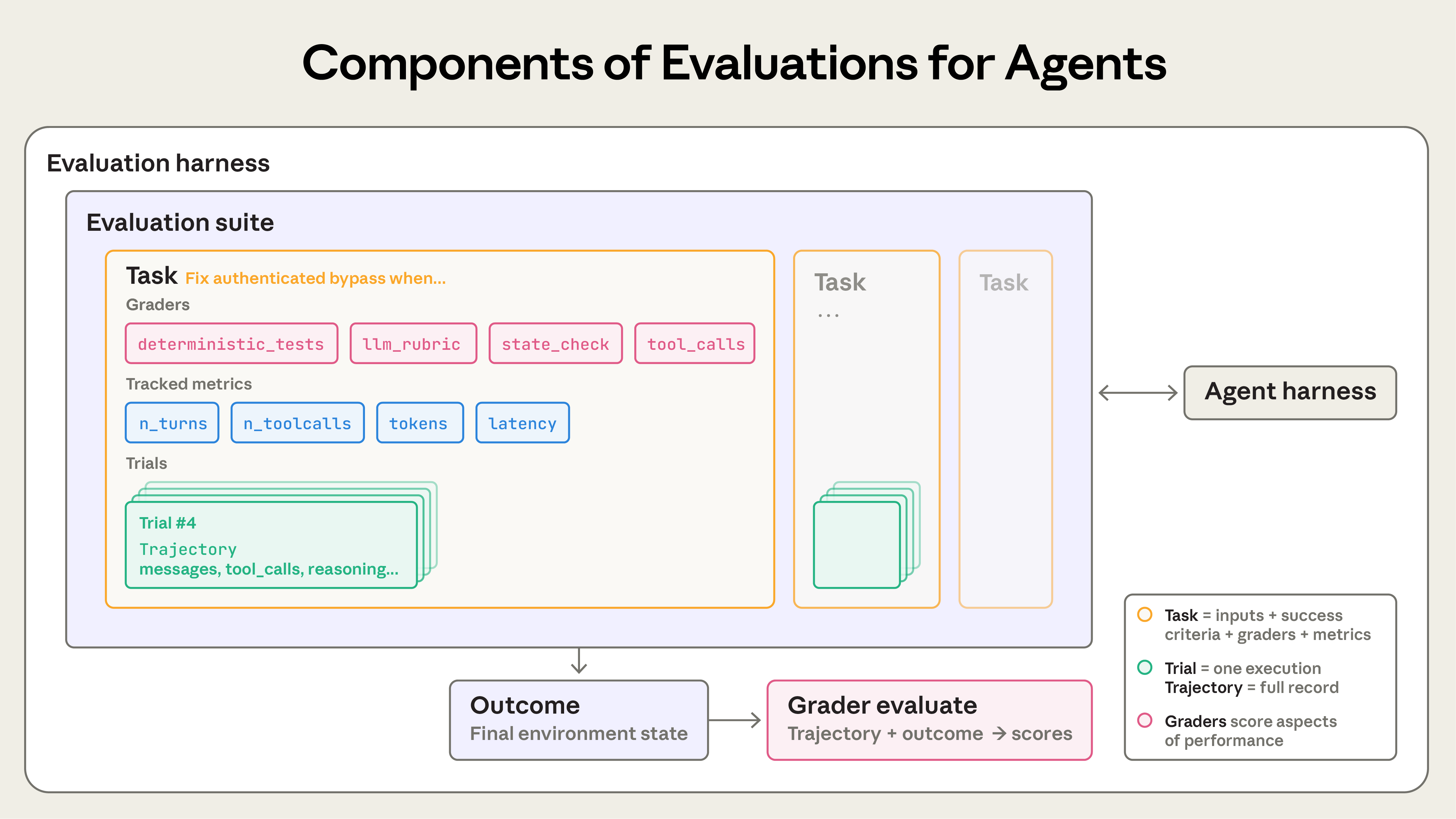
If you’re interested in learning more about evaluations, check out Cameron R. Wolfe, Ph.D.’s articles on agent evaluation and evaluating agents on highly subjective tasks.
The first fundamental flaw of benchmarking
When developing benchmarks, there are two questions we must answer:
What do we want to test? What domain is the benchmark focusing on, and how do we translate that into concrete evaluation cases?
How do we decide if the agent output is considered “good”? Agents are increasingly being applied to complex, long-running tasks that have many correct outcomes and even more paths for an agent to reach those outcomes.
The first fundamental flaw with benchmarking is the subjectivity of the two questions above. Both of these can be answered in different ways, and how they are answered determines what a benchmark tests and how. This nuance is vital for understanding the specifics of what a benchmark tells us.
Additionally, the complexity of the tasks agents are applied to (and that benchmarks must therefore measure) makes it nearly impossible for a benchmark (or even a collection of benchmarks) to adequately measure all use cases for an agent within a given domain. Undoubtedly, a user will use the agent for an application the agent hasn’t been measured or improved for.
To understand this, let’s look at some concrete examples from the industry using the current frontier of software engineering benchmarks.
Right now, four industry-leading benchmarks measure software engineering capabilities:
SWE-bench Pro V2 measures long-horizon, multi-file repository engineering by running the agent in a network-locked Docker container and grades the agent by replaying its git diff in a fresh container against hidden unit tests.
Terminal-Bench 4.1 measures end-to-end command-line engineering by running the agent inside a sandboxed terminal across 66 tasks spanning software, science, ML, ops, and security, and grades the agent by running verification scripts against the final container state.
LiveCodeBench measures algorithmic coding without memorization by testing on date-stamped LeetCode, AtCoder, and Codeforces problems published after training cutoffs and grades outputs deterministically against hidden contest input and output cases.
CursorBench measures how agents handle short, ambiguous, multi-file developer requests by running them on tasks pulled from real internal Cursor sessions and grades the agent with agentic graders alongside tokens, steps, and cost.
While all of these benchmarks test software engineering capabilities, each takes a different approach to doing so because software engineering is a complex, wide-ranging task to measure. Thus, when frontier labs release a new model, they use all of these benchmarks to get a better picture of engineering capabilities because each tells us something different.
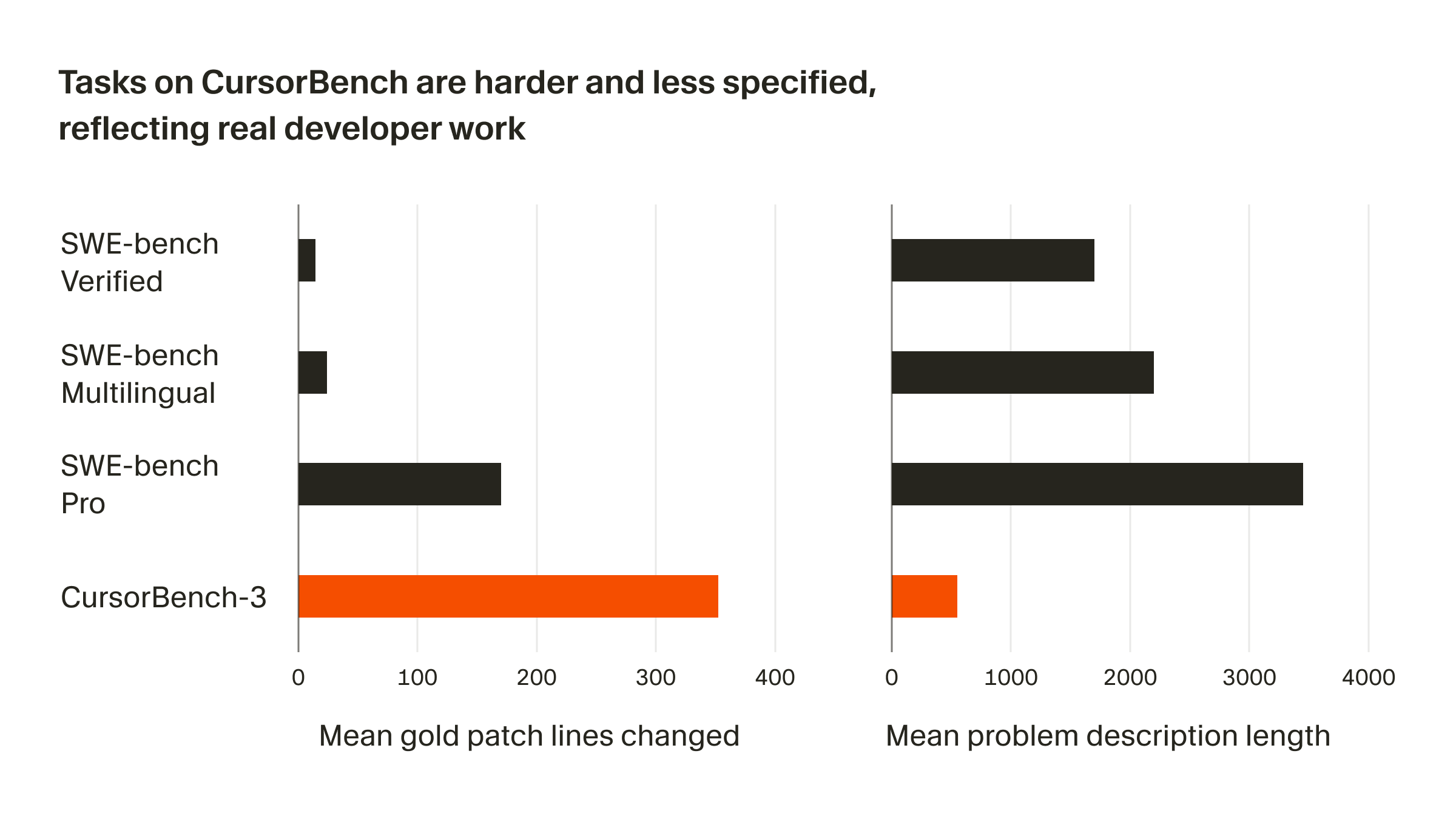
I’ve written previously about understanding benchmark nuance here:

On benchmaxxing
A second fundamental flaw of benchmarks comes from using a benchmark to hillclimb on agent capabilities. While this is one of a benchmark’s primary purposes, this process is incredibly prone to overfitting an agent to a specific use case instead of improving an agent’s general capabilities.
This process is called benchmaxxing, and it’s most often referred to in a leaderboard gaming sense where AI labs use it to inflate model performance. I’m sure this happens, but in reality, it’s actually incredibly easy to accidentally benchmax and bias both agents toward a specific benchmark and even benchmarks to favor specific agents. The second is particularly important when developing your own benchmarks as an AI engineer.
Biasing agents happens when using the benchmark as both the optimizer (used to hillclimb) and the final judge of whether or not the agent got better. This will cause agent development to converge on whatever is needed to maximize the benchmark score. We can mitigate this within the benchmark itself in two ways:
Using a benchmark to hillclimb while keeping a separate holdout set out of the hillclimbing loop. This will be used to evaluate whether the agent actually got better and can generalize instead of overfitting to that specific benchmark.
Continually updating the benchmark with new examples pulled from real production data. If the benchmarking data changes, the agent will have a harder time overfitting. Updating a benchmark continually during development is also fundamental to avoiding saturation. This occurs when a benchmark becomes outdated because most agents can reliably complete evaluation tasks, so the benchmark no longer gives us valuable information.
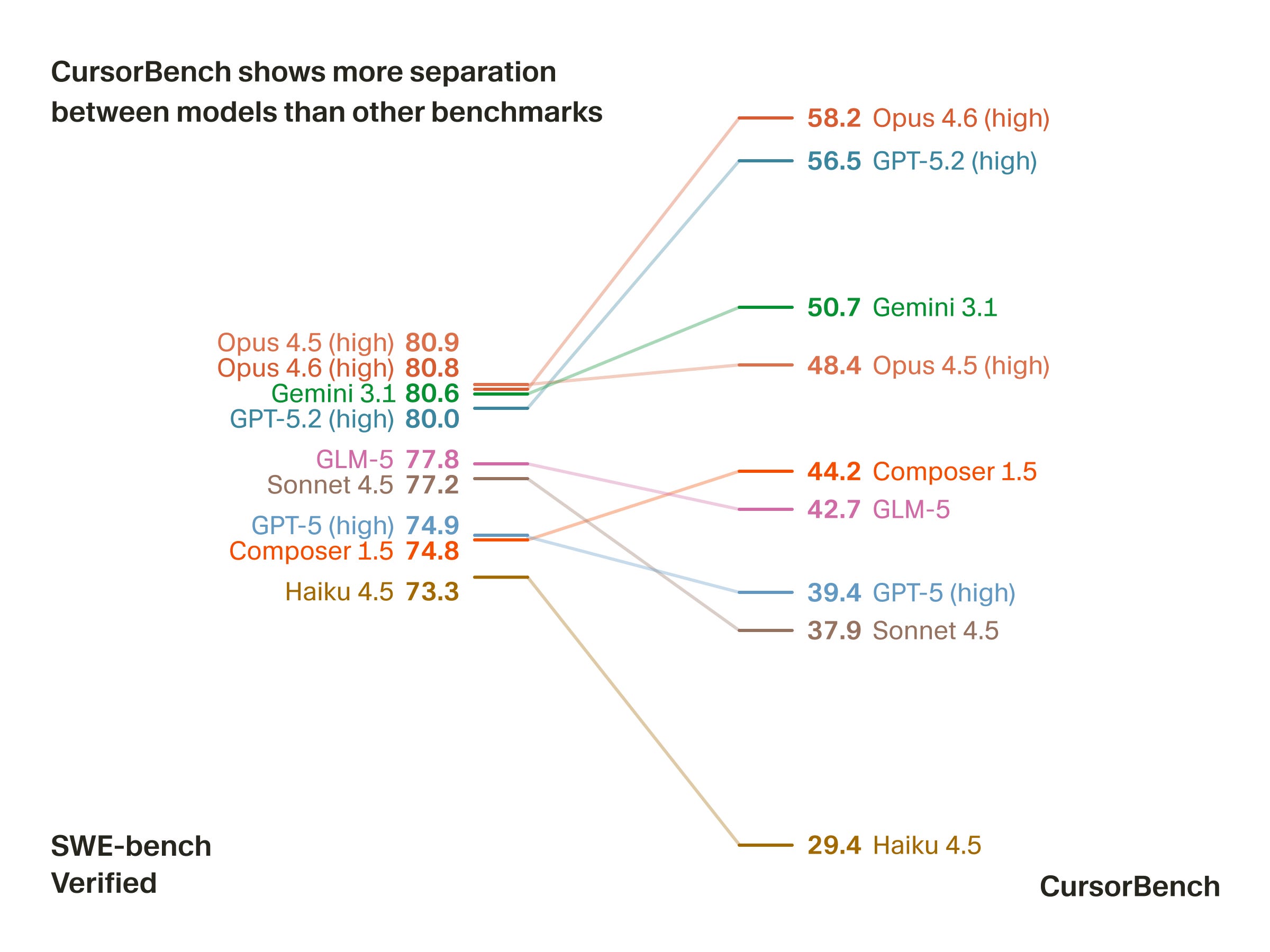
Biasing a benchmark toward a specific agent can easily occur when an AI engineer constructs one tailored to their own agent. This happens for three primary reasons:
Testing the benchmark against a single underlying model (or model class) during development. This tunes the evaluation in favor of how that model behaves. When you swap in another model for evaluation, that model will do worse.
Using one of the tested models as the grader within the benchmark. Models tend to grade their own outputs higher than other models. When one model helps create or grade a benchmark, competing models end up measured on how closely they match that model’s habits.
Building the benchmark through agentic development with a specific model. That authoring model naturally structures tasks, tool interfaces, and edge cases around how it tends to solve problems, putting other models at a disadvantage on the same suite.
The above factors might cause a benchmark you write for your agent to incorrectly prefer a specific agent configuration simply because it’s biased to do so.
What to do when benchmarks aren’t enough
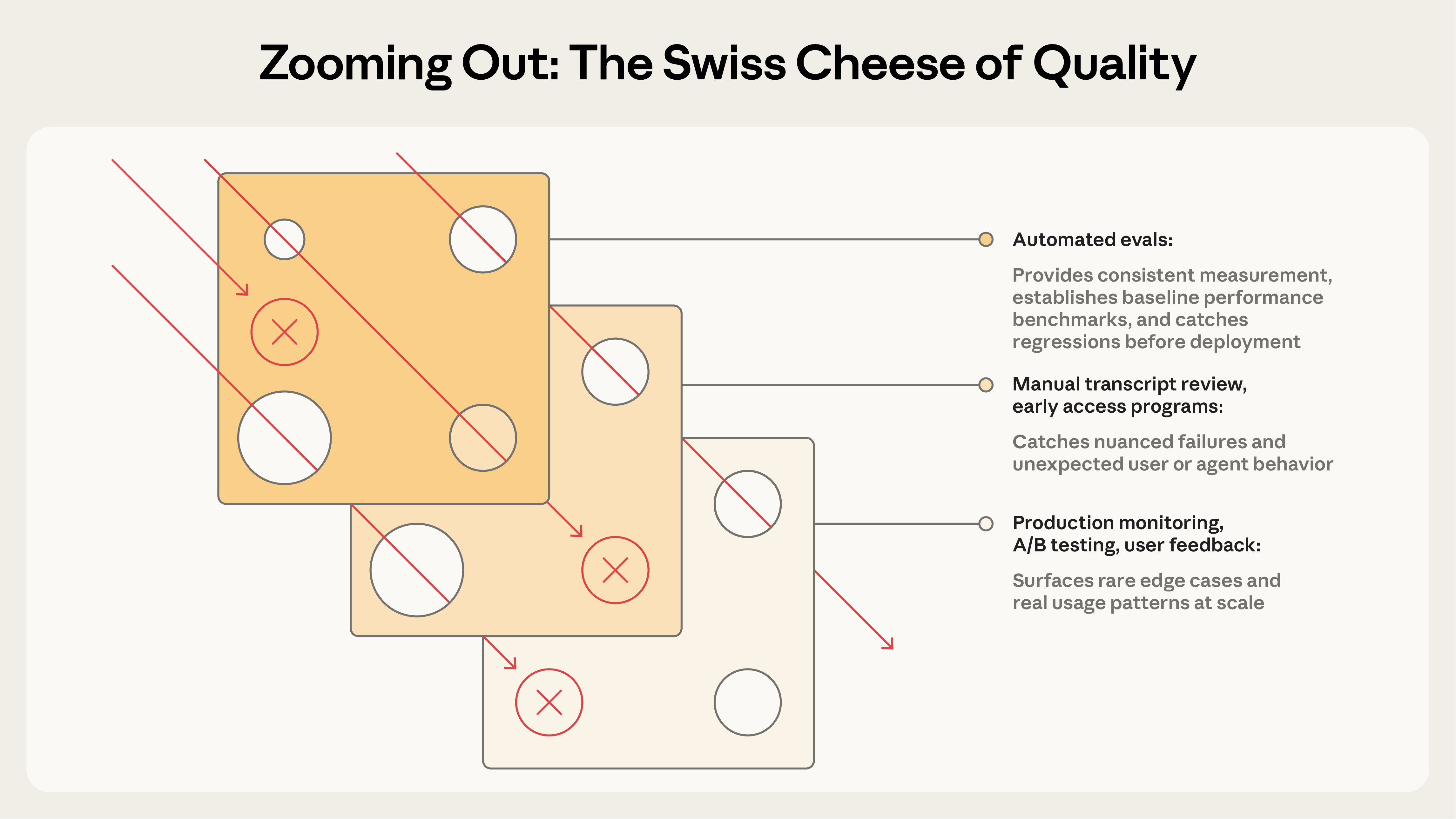
A natural question is whether we should use benchmarks given their known flaws and the engineering effort required to surmount them. The answer is yes. Benchmarks are still vital for the AI ecosystem to quantify agent capabilities, but they should not be the sole evaluation metric. Instead, we combine benchmarking with other metrics to overcome their flaws and capture the user experience of an agent. Focusing there gives us a much clearer picture of real-world use and agent effectiveness.
While teams use several methods to supplement benchmarks in production, two of the most effective approaches to focus on are analyzing real user trajectories and running side-by-side comparisons.
1. Analyzing real user trajectories
Trajectories capture the real user sessions for an agent, including tool calls, intermediate steps, final outcomes, user prompts, and agent responses. They provide you with direct insight into how an agent is used and the user sentiment for how well the agent’s actions fulfill their needs and expectations. Understanding the user experience is vital to analyzing real-world agent use.
The current best approach is human-assisted trajectory analysis, using a simple three-step loop:
Track deterministic metrics first. Watch tool-calling success rates, retry loops, token efficiency, and latency to flag which runs went sideways and where within the run this happened.
Read failing traces by hand. Have an engineer inspect failing trajectories directly to see what is breaking.
Cluster failures and write targeted checks. Use an LLM to group those findings into clear failure categories, then add code assertions or binary LLM rubrics to monitor those failure modes across future runs.
Exactly how we can understand agents via trajectories is something the industry is working on. LLM-based rubric graders and clustering algorithms are of particular interest because they enable automated analysis of trajectories in aggregate. Currently, automated methods are expanding, but human-guided trajectory analysis is still the north star.
An important callout about trajectories is they provide us with real-world use cases and failure cases. This means examples for expanding benchmarks (as mentioned above) can be pulled from trajectories. We can also generate trajectories with desired behaviors and fine-tune the agent on them via post-training. This is a topic for another article.
The most important part of using trajectories is saving and having access to them. This is much easier said than done, as many agent applications contain sensitive data (think personal data, IP, etc.) that needs to be protected. Thus, trajectories need to be scrubbed of sensitive information, locked down to specific individuals, or restricted in how they can be used. Know your industry’s regulations so you understand how trajectories can be stored and used.
2. Running side-by-side comparisons
A very simple but effective way to gain insight into user preferences is to provide users with two different configurations of an agent and have them directly choose which works better. This can be done via side-by-side comparisons within an agent harness.
The user simply prompts two agents (or more!) at once and gets to see the output of each. At the end of the conversation, they decide which agent did the better job, giving the development team insight into which agent configuration performs best on that task via real-world usage and feedback.
Side-by-side testing is especially useful for ambiguous tasks where deterministic grading falls short, and it lets you compare any mix of prompts, harnesses, and underlying models. Top-of-the-line intelligence isn’t always the right answer, and side-by-side testing helps show when a smaller model or lighter agent configuration delivers a better experience.
With enough production traffic, teams pair that with online A/B tests. Signals that look noisy on a single trajectory become much clearer in aggregate across thousands of sessions. Cursor, for example, tests harness and routing changes live by tracking whether users move on to the next task or immediately correct the agent. Data like this is fundamental for producing a true Auto mode in an agent harness where the most effective underlying model is determined for the user to optimize cost, speed, and performance.
Combining these comparisons with trajectory analysis and benchmarking provides a more complete understanding of agent performance and the user experience.
You can read more about other ways to supplement benchmarks here.
If you only take two things away from this article, please make them:
All AI engineers should write their own benchmarks and understand the nuance and engineering difficulties of doing so.
Benchmarks are only so useful, and we need to pair them with real user experience signals collected through trajectories and side-by-side comparisons.
Thanks for reading!
Always be (machine) learning,
Logan
Further reading
If you want to go deeper on agent benchmarks, trajectory analysis, and production evaluation, here are a few good resources:
Demystifying evals for AI agents by Anthropic
Why SWE-bench Verified no longer measures frontier coding capabilities by OpenAI
SWE-bench Pro V2 by Scale AI
Terminal-Bench 4.1 by the Terminal-Bench team
How we compare model quality in Cursor and How Cursor Router chooses the right model for the task by the Cursor team
Q: Why is “error analysis” so important in AI evals, and how is it performed? by Hamel Husain and Shreya Shankar
Agent Evaluation: A Detailed Guide, and Evaluating Agents on Highly Subjective Tasks by Cameron R. Wolfe
How to Use Benchmarks to Build Successful Machine Learning Systems