



I’m convinced that after having a fourth or fifth child exhaustion kicks in and a person’s long-term memory ceases to function properly. I’ve become victim to this and I’ve started taking very detailed notes during meetings. If my brain won’t store the information, something else needs to. As I take notes, I also write down questions that pop into my head about the notes I’m writing down. For example, “What does this mean?” or “Why do we do it this way?” Often these questions are really broad and understood by picking up context as the speaker continues or are answered outright later in the meeting.
In a recent meeting, I kept writing “What does this mean?” next to sentences with the same two words. These terms were used frequently and are terms I hear often at work, but the way they were being used in this meeting didn’t quite line up with what I know. No one else in the meeting had asked about them, so I assumed they knew what was going on. But I didn’t know what was going on so I had to ask. At the next break, I explained my assumption as to what the words meant and asked if that was correct.
And it wasn’t. But no one else’s assumption about the terms were correct either. Those terms are used to mean two different things between the two teams that were present in the meeting. It just so happened that the difference in definitions completely changed the information the speaker was trying to convey based on the definition a listener was familiar with.
Stupid questions are the most important
In this instance, I thought my question was stupid because I was seemingly the only one who had no idea what those terms meant. But if I hadn’t asked it, everyone in the meeting would have missed out on the clarity we all needed.
Communication is made increasingly difficult in software engineering due to the complex nature of the field and the fact that we all like to make up definitions and acronyms to fit our purposes. There are so many times where miscommunication will cause important information to be misconstrued or missed completely.
Most people think labeling a question as stupid means it shouldn’t be asked. I think believing a question to be stupid provides greater reason to ask it. If you can’t decide if a question is worth asking then there is clearly a larger misunderstanding regarding that topic that needs to be cleared up.
When I first started as a software engineer I never asked questions in broader meetings. I had the mindset that if a question is important someone else will ask it. Part of this mentality stemmed from not inconveniencing others, but most of it was because I didn’t want to look stupid asking something dumb.
It took me way too long to realize how incorrect this viewpoint is. First, if everyone takes this approach no one asks any questions. Second, there’s a reason complex software is usually built in teams. These projects require many people to scrutinize them and ask questions to provide clarity for all involved. This helps us bridge gaps in communication that come from the difficulties of software development and learn together.
Now, I ask my stupid questions. Sometimes I might seem like an idiot, but it’s a very low price to pay for the steep upward trajectory it’s had on my technical development. In fact, I can say it’s the single most impactful change I’ve made so far in my career. It’s even helped me in non-work situations1. Instead of wallowing in the unknown, my stupid questions let me join the land of the enlightened. As obvious as this sounds, your questions will never be answered if you don’t ask them.
How to ask a stupid question
I’m not saying there are no stupid questions, because there are. There’s no shame in asking a truly stupid question, but we want to avoid asking them repeatedly. There’s a simple way to remedy this: Make your stupid questions the most specific stupid questions they can be.
Ask specifically about what you don’t know. As you dig around the info you do know to form a better question you’ll often clarify your misunderstanding. Also, specific questions will get specific answers or if you’re way off base they’ll get a clarifying broader answer. Broad questions will never get more specific answers.
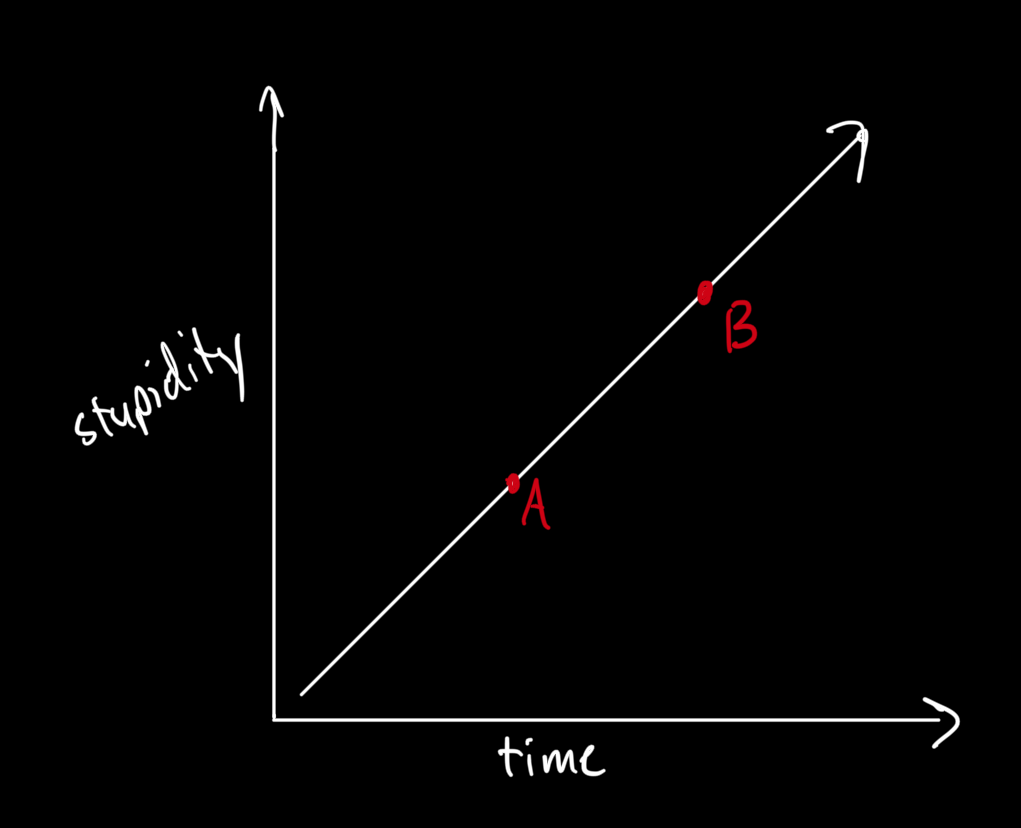
Also, make sure to ask stupid questions early. In my experience, stupid questions get even more stupid over time. Check out the above graphic: It’s much better to ask a question at point A than at point B.
That’s all for this week. Go off and ask your stupid questions! You’ve probably got a backlog at this point. Also, don’t forget to check out the Spotlight below.
Spotlight
One of my favorite technical reads is Abhinav Upadhyay ‘s “What Every Developer Should Know About GPU Computing”. Not only does it share what a developer should know about GPUs, it also provides a great comparison between CPU and GPU architecture in a way that’s easy to understand. Check it out here:

If you’d like to be in the next Spotlight, reach out to me on X or LinkedIn. I’m going to share work I enjoy each week.
Always feel free to reach out with any questions or just to chat.
If this article impacted you, please subscribe and share it with your friends. Thank you for supporting my writing!

If you’re already a subscriber, you can support me for just 100 pennies a month! Support independent writing and let me know you enjoy my articles for just $1 a month.
There have been many times I’ve chatted with someone and they mention their interests and talk about it as if I understand what they’re talking about. In the past, I would nod and move on. Post-stupid question Logan tells them I have no idea what they’re talking about and I end up learning a lot about a topic I never would have otherwise.
I’m glad that my notes are personal because the number of times is write “wtf is this?!” Next to things Is a little absurd - I tend to ask a lot clarifying questions heh
Two things that I do - and I also mentor younger folks on - never say “I have a stupid question...” ask the question but labeling as a “stupid question” doesn’t actually do anything for you or the responder. Saying like “I have a question, it might be a little basic but I want to be sure I’m thinking about this right...” takes an extra 2 seconds but casts the entire conversation in a different light.
The other is a thing you said you did, but glazed over--stating your understanding and asking if it’s correct. Then you don’t even need to ask the “stupid” question, just be like, “so we keep saying x, and I’m taking that to mean Y, is that right?” Helps focus and drive the conversation.
That being said, I’m not above saying “I have a silly question and I would really appreciate if you would humor me...” from time to time, against my own advice :-)
I've been guilty of not asking questions, I would think this is stupid to ask and would waste everyone's time. But once you are on the other side of the table you realize there's no stupid question and it's better if people ask and clarify their missing gaps earlier, rather than go and do things with wrong assumptions.