


I’ve been thinking a lot recently about the efforts to get data centers into space. Specifically, I wanted to understand the motive of doing so, the practical blockers of making it happen, and, most importantly, whether or not it’s actually possible.
In this article, I cover this in three parts:
Understanding the current state of power consumption by data centers and the projections for future requirements. This will focus on understanding the power crisis at large and why power is the fundamental blocker to AGI.
Looking into the theory behind the moonshot of getting data centers in space and why it’s appealing.
Identifying the blockers for getting these data centers operational in orbit and the research and engineering advancements necessary to make it happen.
If you want a quick tl;dr, it’s very possible space-based data centers are the future of AI development for Earth, but this is a moonshot idea. This means there are underlying theories to show it’s theoretically possible, but there are many potential blockers that need to be removed. Moonshot ideas often take ten to fifteen years to materialize (if they materialize at all) and have significant payoff.
Energy consumption on Earth
There are many blockers to getting superintelligent AI into the hands of all people. The most important of which goes beyond research and infrastructure: Power.
AI is fundamentally an energy problem. Training and serving models at scale necessitates incredible power consumption and will grow (likely exponentially) as AI usage grows, the number of models trained grows, and the requirements to run those models increases.
Data centers are being built at an unprecedented rate and there’s concern we won’t be able to meet the energy requirements for running them. This concern is both in the near-term, where we potentially can’t build utilities fast enough, and in the long-term, where we can’t harness enough energy to power them in general.
To better understand current power consumption, we’ll review key metrics from the Powering Intelligence 2026 report. This report provides insight into current and projected energy needs for utility companies. For the purposes of this section, our metrics will focus on US data center power use as I find it not only indicative of data centers around the world, but also at the forefront of data center construction.
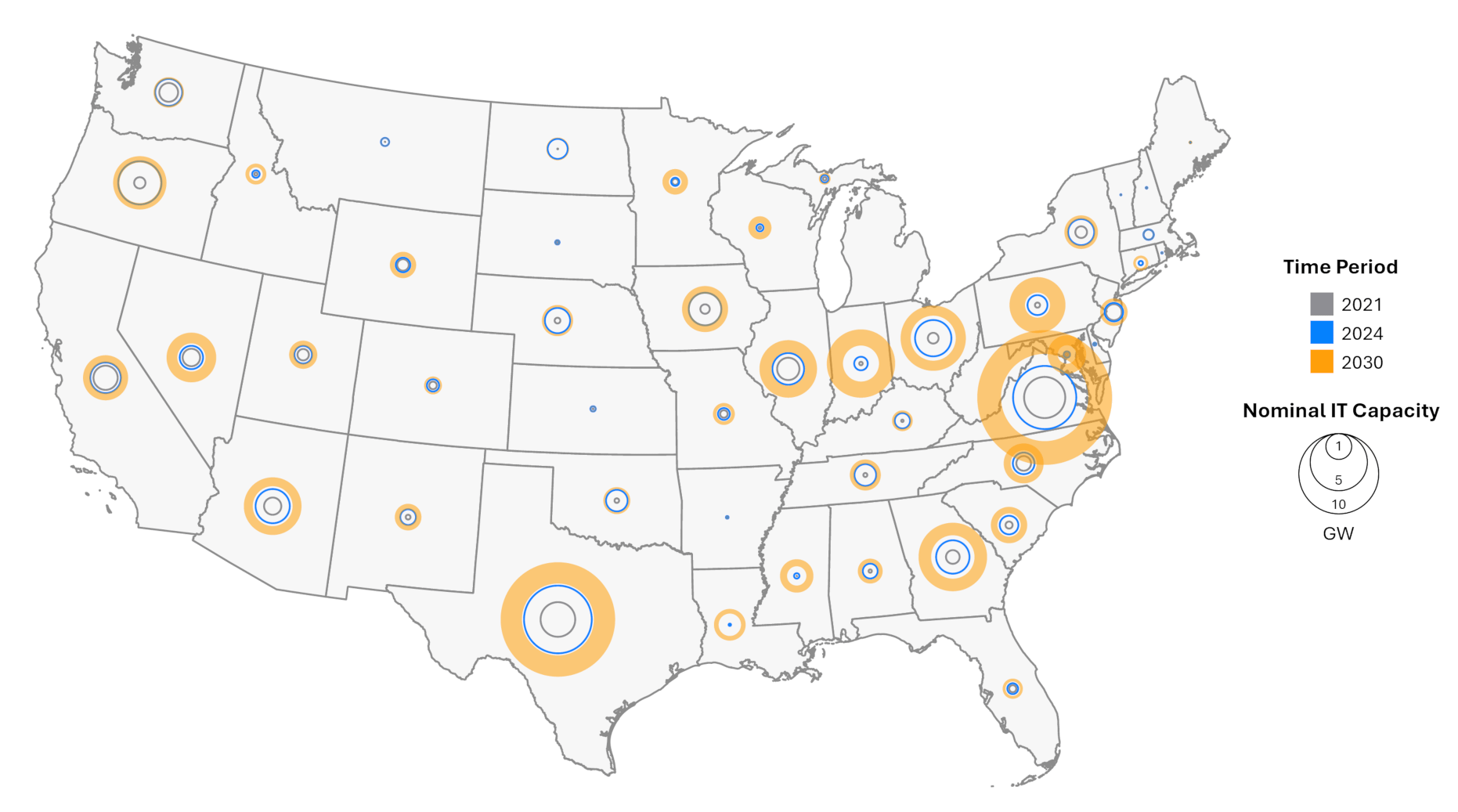
I highly suggest reading the executive summary for the report to get a better picture. Here are metrics to keep in mind when considering the future of data center consumption:
Data centers currently consume 5% of total US electricity. By 2030, this is expected to be upward of 17%.
AI workloads account for approximately 25% of data center electricity use. This comes out to around 192 terawatt hours.
By 2030, US data center consumption is projected to be up to 790 terawatt hours, which marks a 4x increase in a few years.
This increase is driven by AI workloads which require significantly more power than traditional data center use cases (streaming, communications, etc.).
A typical new data center requires power equivalent to that of a new neighborhood housing at least 80,000 and up to 800,000 homes.
Some states see data centers consume nearly 20% of their power (Virginia, currently) and many are projected to reach that point by 2030 (Iowa, Oregon, Nebraska, and Arizona, for example).
Concentrated compute requires an enormous amount of cooling, causing cooling to increase a data center’s power requirements by up to 40%.
Forecasted energy demand will be met primarily via natural gas.
The most important takeaways are understanding the current power consumption of a data center and the rate at which this is expected to increase. By my estimates, consumption will likely increase faster than these projections. This report takes current construction plans into account, but doesn’t dig deeper into how advancements in AI will increase these numbers. We’re likely to see different power requirements due to:
An increase in usage
New model architectures
The training and serving more models
Scaling models up
In short, power will quickly be the bottleneck for general intelligence. Construction of data centers in orbit is one of the proposed methods to fix this bottleneck.
If you want to learn more about the current state of power consumption, read the Powering Intelligence 2026.
Why send the data centers to space
One of the moonshot ideas coming out of multiple companies to combat the power consumption issue is to put data centers in space. The primary motivating factor is harnessing more of the energy given off by the sun.
“The only place you can really scale is space. Once you start thinking in terms of what percentage of the Sun’s power you are harnessing, you realize you have to go to space.” - Elon Musk
This is explained well by Elon Musk in an interview with Dwarkesh Patel where he explains SpaceX’s motivation for getting data centers into orbit and the path forward for doing so. I highly recommend watching the entire thing, but the clip attached to this tweet (Substack doesn’t load even a media preview, for some reason) is particularly insightful:

Simplified, Elon lists the following benefits for putting data centers into space:
Constantly harnessing solar energy. On Earth, we deal with a day-and-night cycle and atmospheric factors that block solar arrays from constantly harnessing energy. In space, these don’t exist and energy can be harnessed constantly. This harnessed energy will be used to run the data centers.
Less infrastructure for the solar cells to provide energy. This includes batteries to deal with the lack of sun exposure at night, protective casing to protect from atmospheric events, and more. This makes the solar arrays significantly less expensive when utilized in space.
Regulatory slow-downs are removed. It’s incredibly difficult to make a deal with utility providers on Earth for many reasons. This significantly slows down the velocity of energy production.
Whether you love or hate Elon, I’ve found him to be good at understanding the problem space he works in—he just tends to be aggressive with his time estimates for technologies to be brought to production. While he puts a target timeline at 30-36 months before it becomes economically feasible, a Google study puts it much further out and closer to the mid-2030s (see the next section).
If you want to learn more about the motivation behind SpaceX sending data centers to space, I suggest watching the entire podcast:

What makes space difficult
To understand the significant blockers, we’ll take a look at Google Research’s preliminary research into the most key potential problems and what they found. Google Research completed many simulations to better understand the limitations of space-based data centers and plan to launch satellites at a small scale sometime in 2027 to start testing their theory in space.
Below are the primary blockers Google Research found and their potential solutions where applicable. I’ve included these in the order I feel to be most significant to least significant blocker.
1. Thermal Retention
The biggest difficulty lies in cooling. On Earth, we cool data centers via a combination of air and water cooling. In Space, there isn’t an atmosphere to do so. The only way to dissipate heat is via radiative cooling which is highly inefficient. Essentially, all data centers in space would need massive metal plates to cool themselves. These heat from the data centers would use these plates to transfer from the data center.
Google is still researching this and doesn’t include a solution in their write-up. Some of the solutions to thermal retention I’ve seen are researching chip designs that can run at a higher temperature so they don’t require as much heat dissipation and making smaller interconnected satellites so each satellite doesn’t generate too much heat potentially making it easier to dissipate.
Furthermore, because manual hardware replacement is impossible in space, the system requires redundant provisioning and fault-tolerant networking software to manage hardware failures. This area needs to be further explored because heat dissipation is a difficult problem on Earth and only becomes more difficult in space.
2. Space Radiation
Earth’s atmosphere and magnetic field largely protect us from space radiation. As we put data centers in orbit, we need a way to protect them from radiation as necessary to ensure they compute properly.
Google tested TPU resiliency to radiation by blasting TPUs with a proton beam. It showed high bandwidth memory to be the most sensitive component and susceptible to random bit flips caused by radiated ions. They found irregularities to show after a cumulative dose of 2 krad or three times the expected dose of a five-year space mission.
In Elon Musk’s explanation of data centers in space, he mentions that LLMs with trillions of parameters are resilient to random bit flips because a single bit flip shouldn’t affect model output. Intuitively, this makes sense; however, much of data center infrastructure code is still traditional programs with heuristic logic. A single bit flip in those programs can result in unforeseen bugs or complete system failures. Additionally, it’s possible future large AI model architectures won’t be quite as resilient.
Radiation effects manifest as memory irregularities, uncorrectable errors, and silent data corruption that threaten model training accuracy and operational stability. In order to create reliable data centers, the impact of space radiation must be understood or silent failures could render data centers useless.
I find space radiation itself to be fascinating, if you’re interested you can learn more about it here.
3. Ground Communication
The large majority of AI computation performed in data centers is inference. A key requirement for a great AI user experience is fast inference. A user needs to prompt the model and get results in a timely fashion. Orbital data centers must deliver the same speeds to be as effective as their Earth-bound counterparts.
Google Research acknowledges this as one the most pressing and difficult engineering challenges to achieve orbital data centers. Google is partnering with Planet to better understand how this can be done.
The satellites launched in 2027 will be used to validate communication between satellites (see the next section) and communicate between communication clusters and the ground.
Pulled from Google Research’s blog post. Evolution of a free-fall (“no thrust”) constellation under Earth’s gravitational attraction, modeled to the level of detail required to obtain sun-synchronous orbits, in a non-rotating coordinate system, relative to a central reference satellite S0. Arrow points towards Earth’s center. Magenta: nearest neighbors of satellite S0. Orange: Example "peripheral" satellite S1. Orange dashed: S1’s positions relative to the cluster center (in the non-rotating coordinate frame).
4. Fleet Control
The primary motivator for large-scale data centers on the Earth is the ability for compute clusters to communicate with one another across high-bandwidth cables for fast communication. To replicate this communication speed, satellites in space must communicate at tens of terabits of data per second, meaning their communication must be tens of thousands of times higher than typical long-range deployments. In practice, this means they must fly just hundreds of meters apart.
This introduces an orbital dynamics problem: satellites must remain in position with another in low-altitude orbit. Due to atmospheric drag and the non-spherical shape of Earth’s gravitational pull, these satellites could drift out of alignment and sever their high-speed connections.
Additionally, to get the most benefit out of data centers in space, the orbit of these satellites must remain within direct sunlight. This means the cluster of satellites must follow a specific orbital path around the Earth to maximize benefit, further restricting their potential orbital patterns.
Google ran many numerical calculations to understand this orbital pattern and found that the cluster of satellites would need to be capable of station-keeping maneuvers to maintain their proper placement. Luckily, these maneuvers would be slight and remain in the realm of possibility.
If you want to understand more about data centers on Earth, check out my recent article on Decoupled DiLoCo, Google’s algorithm for asynchronous model training across regions:
Decoupled DiLoCo: How Google Is Enabling Multi-Region, Distributed LLM Pretraining

Large-scale LLM pretraining is a notoriously complex and resource-intensive process. Training these models can involve up to hundreds of thousands of AI accelerators being colocated. This physical requirement ensures high-bandwidth cabling can connect these accelerators, enabling low-latency communication between them.
5. Economic Feasibility
Historically, the cost of launching a single payload into space has been prohibitively expensive. However, Google’s own simulations have found that by the mid-2030s, launching payloads into space could be as inexpensive as $200 per kilogram (currently around $3600 per kilogram using the reusable configuration of SpaceX’s Falcon 9). This relies on the commercial space industry maintaining its current learning rate and the ability to reuse rocket boosters.
At that cost, space operations become much more economically feasible to the point where launching and maintaining an orbital data center becomes comparable to the costs of running a data center on Earth. This would make orbital data centers a more economically feasible alternative to Earth-based compute. This doesn’t align with Elon Musk’s timeline of 30-36 months, but much of this timeline depends on the research and development of the commercial industry.
Economic feasibility also depends on the reliability of GPUs and other necessary compute infrastructure. When GPUs fail in space, there’s no good way to service them. If it’s necessary to construct the infrastructure for humans to man these stations or visit them to fix infrastructure, economic feasibility needs to be reassessed.
In conclusion, orbital data centers are a moonshot venture. While they’re theoretically possible and majorly beneficial, there are significant technical and physical hurdles that need to be overcome with further research and experimentation.
If you’re interested in learning more, please check out the following resources:
The Powering Intelligence 2026 report to understand current utility demands.
The Dwarkesh Podcast with Elon Musk discussing orbital data centers.
Google Research’s preliminary work validating the feasibility of orbital data centers (blog post and paper).
More information on space radiation from NASA.
My previous article on Decoupled DiLoCo to understand AI infra and how Google is making it asynchronous.
Thanks for reading!
Always be (machine) learning,
Logan